

Picture this: You’re running late for a medical appointment, standing in a sprawling hospital corridor, squinting at a faded wall map that hasn’t been updated in years. Or maybe you’re dragging luggage through a busy airport terminal, desperately searching for a gate that shifted terminals ten minutes ago. It’s a familiar, frustrating reality we’ve all faced. But indoor navigation is finally catching up to the GPS apps we trust outdoors. Today, digital wayfinding is quietly reshaping how we move through complex environments, turning daily confusion into calm confidence with smart, real-time guidance that actually works.
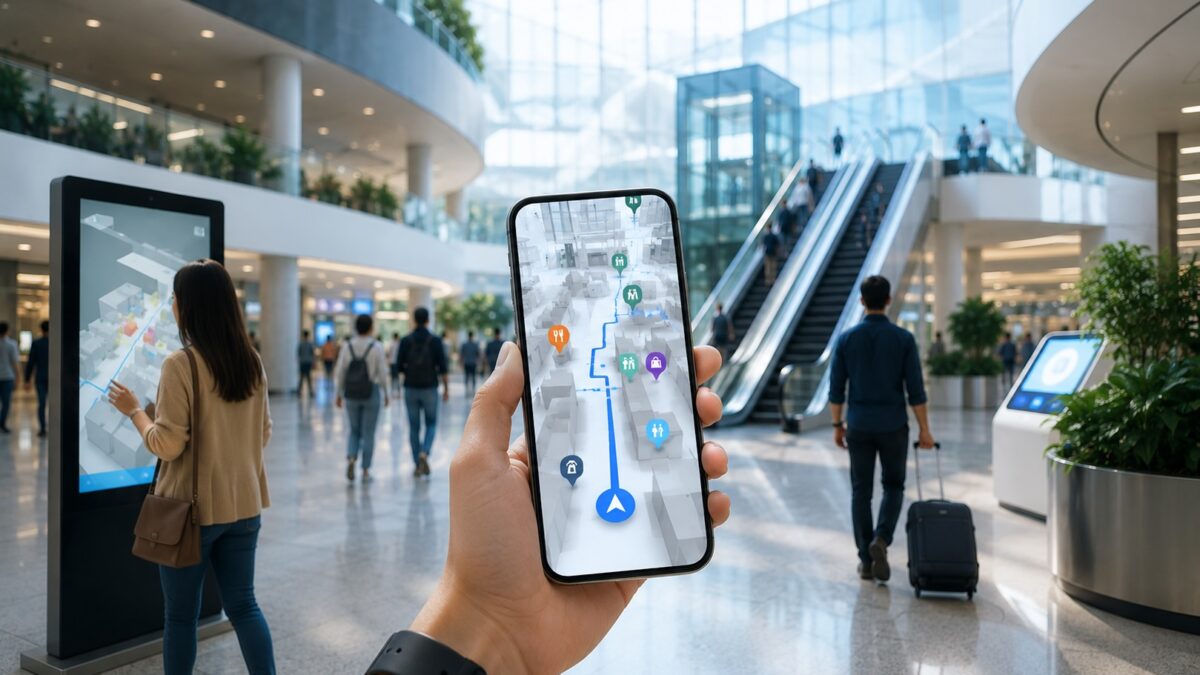
Why Static Signs Are Failing Modern Spaces Fixed signs worked perfectly when buildings stayed still. But airports change gates, hospitals relocate clinics, and convention centers completely flip their floor layouts overnight. Relying on printed markers in dynamic environments is a recipe for missed connections and wasted time. Modern digital wayfinding solves this by layering interactive screens, touch kiosks, and mobile apps into one connected ecosystem. Instead of guessing or asking three different staff members for directions, visitors simply tap a destination and get instant, adjusted routes the moment a room moves or an escalator goes offline.
The Tech Powering Seamless Indoor Navigation Outdoor GPS drops you at the front doors, then leaves you to figure out the rest. Smart indoor mapping bridges that gap using Wi-Fi triangulation, Bluetooth beacons, ultra-wideband, and visual positioning to pinpoint your exact location inside multi-story buildings. When you pair that precision with AI-driven traffic analysis, the system stops being just a map—it becomes an active guide. It predicts bottlenecks, reroutes you around crowded lobbies, and even suggests quieter entrances during peak hours.
For venue operators and daily commuters alike, the core benefits are immediate:
- Live Adaptive Routing: Directions update instantly when schedules shift, corridors close, or event layouts change.
- Cross-Device Continuity: Plan your route on a mobile app, tap it at a lobby kiosk, or scan a QR code—guidance follows you seamlessly from parking to your final destination.
- AI Foot-Traffic Optimization: Smart algorithms analyze real-time crowd flow to prevent bottlenecks and balance visitor distribution across large spaces.
- Universal Accessibility: Step-free path options, high-contrast displays, multilingual voice prompts, and screen-reader compatibility ensure every visitor gets equal, stress-free guidance.
Less Anxiety, Smarter Venues, Better Experiences Navigation isn’t just about getting from Point A to Point B. It’s about how you feel while doing it. Recent studies on augmented reality and interactive indoor navigation show that visitors complete tasks significantly faster, make fewer wrong turns, and report noticeably lower anxiety than when relying on traditional paper maps.
Behind the scenes, facility teams gain an equally powerful advantage. Search data and heatmaps from kiosks and apps reveal exactly where people slow down, which service desks are most requested, and how to optimize staffing or physical signage. The global shift toward connected smart buildings means visitors now expect indoor spaces to feel as intuitive as their favorite apps.
Digital wayfinding is no longer a premium add-on; it’s the backbone of modern venue design. Whether you manage a transit hub, a corporate campus, or a multi-level retail center, these intelligent navigation systems eliminate the guesswork and elevate every single step of the visitor journey. If you’re ready to replace endless hallway confusion with clear, real-time guidance, upgrading to smart digital wayfinding is the most impactful step your space can take. Find your way effortlessly, and let every visitor focus on what actually matters.